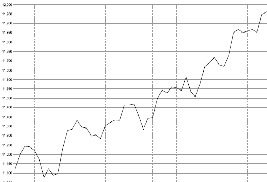
A Tough Call

Stable market share positions among the main players in an industry combined with high returns on capital typically are evidence of a long-term competitive advantage. I made a mistake by not weighting this heavily enough in my initial assessment of Motorola (MOT) several months ago. I also did not consider enough the unpredictability of mobile phone industry dynamics. While MOT benefits from scale in distribution, relationships, and the ability to spread fixed costs, including as R&D and advertising, over a larger revenue base than its smaller competitors, the short product cycles and the need to continually innovate products, combined with a smaller, more powerful group of buyers (mobile phone companies that have been consolidating) have made the company’s plight that much more difficult.

In late 2006, I made a buy decision on Motorola (prior to the disclosure that Icahn was involved) based primarily on a few facts: 20% of its market value was in cash, and this cash could be used, among other things, to wipe out its debt and buy back loads of shares. Over the past few years the company had generated copious amounts of free cash flow and that looked reasonably certain to continue. But I soon found that the stock price was down for a good reason. Management had turned to the dark side - managing for market share, not profitability. Profits quickly turned to losses and cash flow evaporated when pricing power faded and unit sales slumped. In March, I sold July call options on the stock. So after being called out a few days ago the investment netted at breakeven (loss on the stock, gain on the option). Over this same period, the S&P 500 was up over 5%, so I consider that the opportunity cost of the investment in Motorola.

The company will probably recover and thrive again. But I came to the conclusion that I am not smart enough to figure out when that will be or how it will occur. If they come out with another product line as revolutionary as the RZR, certainly profits will return in spades. But after that phone comes on the market they’ll need another one to follow it. And now that Apple (AAPL) has entered the mobile phone space, the competition for innovative products is even more fierce. Overall, the visibility of the industry is low to me. So if in a few years I see the stock at double its current price, it won’t faze me because it fell outside my circle of competence. The uncertainty of the commodity cell phone business no longer makes Motorola the no-brainer that I like to see in a stock before I pull the trigger.

Full disclosure: No positions in the companies mentioned.

Subprime Concerns Again!

The concern from the subprime market continues to spill over into the stock prices of companies such as Countrywide Financial (CFC) and others. Countrywide has been the subject of frequent posts and that mainly is because (1) I own the stock so I’m watching it and (2) subprime concerns have caused its price to bob around well under intrinsic value for some time now. And now its share price is back under $35 apiece amidst renewed subprime concerns (less than 10% of its business was subprime).

The latest news regarding subprime is that two Bear Stearns hedge funds that specialized in subprime mortgage-backed bonds have ended up virtually worthless. Much of the reason the funds went down so fast was likely due to the leverage employed, as the index that tracks subprime loans originated in the 2nd half of 2006, the ABX "BBB" 07-1 index, fell to nearly its lowest level ever over the last couple days.


This is a classic illustration of the market being irrational longer than one can remain solvent. Yet these funds were probably using “risk controls” that considered the probability of such an event as so miniscule that they ignored it (based on the dubitable "proof" of historical data or simulations heavily contingent on multiple assumptions). Turns out the risks were higher than the so-called models told them. Looks like they opted to be precisely wrong rather than approximately right.

Over the past few years, anyone could sell a mortgage. Just get in touch with GMAC, provide the documentation they want, and get paid a fee based on each mortgage obtained for them as a broker. GMAC (and many others) in turn would package the loans together and sell them to investors. So the accountability was really lost at each stage while the packaging, or securitization, process mysteriously turned a group of loans into investment grade despite the dubious characteristics of its individual constituents. Downgrades in these bonds over the past few weeks have called into question the quality of the underlying loans and hit these two funds very hard.


I think underwriting standards today are likely to have improved overall (yet, even though its only anecdotal, I still see advertisements touting “no down payment” loans available). But overall, going forward, the lax lending standards have likely subsided and overall loan quality has probably improved (that is, until the next boom period for housing). For originators whose loans are sold through securitization, the bigger players are the ones that will benefit long-term as smaller competitors are shaken out. This includes Countrywide, Wells Fargo (WFC), and other large banks such as Bank of America (BAC) and Washington Mutual (WM).

Full disclosure: Long shares of all companies mentioned.

A Quick Word on Sears Holdings

I want to post a quick commentary regarding Sears Holdings (SHLD), a company I have admired (from the sidelines) for quite a while because of its Chairman and owner of 42% of its stock, Eddie Lampert. The stock was down over 10% yesterday on the heels of a reduced earnings outlook, making the shares more attractive.

Sears is a company that throws off solid free cash flow and continues to buy in shares opportunistically. For any company, what matters should not be size or market share for their own sake but profitability in the markets in which it operates. Lampert is keenly aware of this and is managing for profitability. I would compare this to Warren Buffett not growing premium volume just for the sake of having a larger policy base. There have been 10-year periods for Berkshire where premium volume shrank in every single year, but profitability on those in-force policies remained solid. Lampert is a Buffett disciple, so there is ample reason to believe he looks at Sears in a similar way. I think he’s willing to shrink the total size of the “empire” as long as he, per-share, grows wealthier.

If the Sears (and Kmart) business as a whole shrinks, the stores that are still around will be more profitable in their individual markets. What remains of a smaller, more profitable company will have low reinvestment requirements (since it’s just maintaining what it already has). This will lead to even more robust free cash flow (and proceeds from real estate sales) to use for even more opportunistic buybacks. Using this procedure, Lampert can increase per share business value at a steady clip even while aggregate sales and net income decrease.


As an example of his influence on a company, look at what he’s helped orchestrate at AutoZone (AZO), of which he owns 31%. Since 1997, sales and profits at the company have risen 9.2% and 12.7% annually, but 18% and 22%, respectively, on a per-share basis. They’ve done this by focusing on profitability (net profit margin has gone from an average of around 7% to nearly 10% over that time period) and have used increasing free cash flow to buy back heaps of shares. And the stock has followed, up nearly 20% annually over that time.


Full disclosure: No positions

A Stock to Go with Those Jeans

A stock that has recently come onto my radar screen is that of American Eagle Outfitters (AEO). I must admit that I do not shop at their stores, but I do walk by them during my infrequent sojourns to the local mall. I find the stores to be clean, well put together, and the fashions to be relevant (as judged by the fact that the teens walking around the mall are wearing what I see in their store). I also know a few teens in the core AEO demographic who provide me with knowledge on what fashion trends are out there (I bought the stock for one of them). The company’s core target is 15-25 years olds, and its new concept store, Martin+OSA, targets 25-40 year olds.

Obviously the most important thing for a teen retailer is to have the knowledge of not just current fashions but what will be fashionable in the near future. Keeping “on-trend” is crucial. AEO management has consistently done this for the past ten years or so, by using focus groups and extensive market research to remain relevant. And its clothes are lower-priced than Abercrombie and Fitch (
ANF), one of its main competitors, which bodes well for less heady times for retailers.

AEO shares are just 2% off a 52-week low, and are probably sitting there because of concerns about revised (downward) quarterly guidance. But it is the longer-term that I am concerned with, and there is much to like here. For one, I like the recently announced 23 million share buyback, representing 10%+ of outstanding shares. Its Chairman (and founder) owns about 14% of outstanding shares, so his interests are aligned with minority shareholders. The stock trades with roughly 15% of its market cap in cash and a free cash flow yield of nearly 10% based on its 2006 results. Even with growth slowing (which it inevitably will), the company can throw off lots of cash.

At first glance, it looks like the company has no long-term debt on the balance sheet, but it holds about $975 million (present value) worth of operating leases off-balance sheet. That makes its true debt-to-total capital ratio about 40%. So you’re really getting a 12% return on total capital (20%+ return on equity) at a P/E of 13.5. If the company can continue to grow at 5-10% over the next few years, this works out to a fairly cheap price, even if the growth is lumpy. And if its new Martin+OSA stores take off, the shares could look very cheap in retrospect 5 years from now. At current prices, the market seems to be offering a good price for the core business and what more or less amounts to a call option on the Martin+OSA brand for free. And if Abercrombie continues to fall (down over 4% today), its shares could start to look attractive.

Full disclosure: As mentioned, long AEO.

Best Buybacks

Best Buy (BBY) today announced a 30% boost to its quarterly dividend and a $5.5 billion buyback program (replacing its previous $1.5B program), $3.0 billion of which will be done immediately. This should reduce share count by over 13% at today’s prices, giving shareowners who hold on a bigger piece of the pie. Given the company’s cash-generating ability (a roughly 5% free cash flow yield after capital expenditures needed to maintain and expand the business are subtracted) and the currently undervalued state of its shares, I think this is a great use for the company’s cash and view this as a shareholder-friendly move as long as buybacks occur at sensible prices.

More good news was announced: management now targets 1,800 stores in the U.S. and Canada (up from 1,400), which represents a near doubling of its store base domestically. Assuming returns on invested capital can be maintained even with such a sizeable store base, Best Buy – the company and its stock – continues to look attractive at current levels (though I certainly wouldn't mind if they went lower in the short term).

Full disclosure: Long BBY shares.

Best Buy in the Crosshairs

I love a good growth company. Good growth businesses are even better when paired with long-tenured managers who own a significant amount of shares while presiding over a great track record of growing earnings and free cash flow and earning high returns on incremental capital. Furthermore, the situation is even better when the current stock quotation undervalues the business. These factors all may be characteristic of Best Buy (BBY) at its current price.

Best Buy announced quarterly earnings today that were 18% lower than the comparable period last year and shares are down nearly 6% on the day. Much of the decline in profits was due to a shift in revenue mix to lower-margin products such as flat-panel TVs, notebook computers, and gaming hardware. So is the selloff in the shares warranted? Are lower margins forever in Best Buy’s future? Those selling off shares today seem to think so.

The main concern swirling around Best Buy seems to be that of a sharp downturn in consumer spending. Though likely to slow a bit, betting against the consumer has not historically been a good gamble. In addition, Best Buy continues to take market share from competitors such as Circuit City (CC), which will help mitigate the pressure on its business in the event of a slowdown in consumer spending. But concerns about consumer spending represent short-term thinking. Investors in common stocks should typically think in longer time horizons. Are the company's competitive advantages intact? Can Best Buy grow while continuing to earn good returns on total capital? Over the longer-term, it seems highly probable that Best Buy can continue to grow and prosper both domestically and internationally. For instance, Best Buy holds a potentially valuable option in its Chinese operation, where it now has just one store.

There is a longer-term risk to profitability: Wal-Mart (WMT). I believe Wal-Mart will continue to be a fierce competitor but probably only on the lower end. Its main advantage is obviously price. Yet Best Buy offers more qualitative advantages: clean stores, great selection, a cool environment, and great service, and often consumers go there first if it’s electronics they crave. The wider selection and more knowledgeable staff (rather than someone who also works in fabrics or grocery) give Best Buy an edge over Wal-Mart in its core customer base for years to come.

As for profitability, for the past ten years returns on total capital have been around 20% on average (due to a modest debt load, returns on average equity have averaged a couple of percentage points higher). The lowest-return years of the past ten were 2001 and 2002 (recessionary conditions) and returns in those years were still quite satisfactory at 17.1% and 17.8%, respectively. Sales have risen 13.7% annually while store base has grown only 12% over this same period. Management stated in today’s press release that new store openings continue to produce 20% returns. These are great numbers and are evidence of a competitive advantage.

The stock currently trades at 15 times forward earnings based on the low end of management’s updated guidance for 2007. This compares with the stock’s average P/E in the 18-20 times range over the past 15+ years. Debt represents about 9% of capital. Management has been buying back shares and increasing the dividend payment steadily since initiating payments in 2003. Chairman Richard Schulze still owns 15% of the company. Even while steadily expanding its store base (the company has ample room to grow) and investing in existing stores, the stock’s free cash flow yield is roughly 5% at today’s price levels. And the company has $2.8B in cash and short-term investments (13% of market value) on the balance sheet. Back out the cash ($5.70/share) from today’s price and the stock trades at 13.5 times forward earnings. Hardly expensive for a business generating such high returns on capital if the returns are sustainable.

At today’s price level (roughly $45/share), taking a small position is likely to yield good long-term returns. Yet the stock doesn’t look cheap enough yet to load up. Unless something has fundamentally impaired the business, if the stock price continues to fall, I may be inclined to provide some liquidity to panic sellers.

Full disclosure: Long shares of Wal-Mart at time of writing.

Some More WB Wisdom

To paraphrase Warren Buffett:

"Be willing to look foolish as long as you don't feel you have acted foolishly."

Rumors Swirl Around Countrywide Again

Countrywide Financial (CFC) shares are up over 7% in today’s trading on no apparent news. Is this just speculation or another case of trading ahead of an impending deal announcement? Stories of the latter have been in the financial press in recent days regarding suspicious trading activity surrounding the take-private deal for TXU (TXU) and Rupert Murdoch’s recent buyout offer for Dow Jones (DJ). In fact, a complaint has been filed against a couple that allegedly bought Dow Jones shares just two weeks ahead of the offer announcement.

So is Countrywide a viable takeover target? I’ve argued shares looked cheap in the mid-30s but with the stock advancing nearly 20% since then, the margin of safety in purchase price does not appear to be as great. Yet in the hands of the right buyer Countrywide would be worth quite a bit more than its recent quotation of $41 and change. And if it doesn't get purchased, t
he company should continue to grow shareholder value - gaining market share in both origination and in servicing (both businesses with scale advantages), as the mortgage market “rationalizes.”

Countrywide is no stranger to buyout speculation. Shares ran up in a similar manner at the end of January on takeover rumors that never materialized. We’ll just have to wait and see if there is any substance to the move this time.


Full disclosure: Long CFC shares.

MSFT-YHOO?

Microsoft (MSFT) to buy Yahoo (YHOO)? I must confess that can’t see an acquisition happening, but I suppose it’s possible. The market seems to believe something will happen, given Yahoo shares are up over 15% today. With Google (GOOG) owning over half the market, and growing at more than double the rate of Yahoo’s and Microsoft’s respective online advertising efforts this past quarter, I believe each needs to take action to become more competitive in this arena.

Larger players (in terms of market share) benefit from the network effects inherent in this space, as Google has shown. The combined MSFT-YHOO entity would control 32% of the worldwide search market, compared with roughly 54% for Google, based on March numbers. So it gets them a little closer to Google’s market share, but still a distant second.

The ability to spread the operational infrastructure across a larger base of users is a powerful force; the broader the network, the more valuable that network becomes. As goes Metcalfe's Law, the value of a network is proportional to the square of the users in that system (i.e. n-squared). Google is the most popular search destination, but also boasts a huge network of third-party sites on which to place ads. Yahoo has the most popular online "portal," but has not been as successful at monetizing its position as has Google. There's not much to say about Microsoft.

That said, the result of combining Microsoft and Yahoo’s online advertising capabilities will be a more robust platform for advertisers, but likely won’t change much for users of their sites. I think an integration of some sort makes strategic sense for both parties. But what makes more sense to me here is a joint venture, not a merger. With a merger, the two companies would have a difficult time integrating the two cultures. Certainly that is one of the strengths of Google – a culture that encourages innovation in this space. Trying to put together two disparate cultures into one company would likely be to the effort's detriment.


This is a situation that certainly bears watching: (formerly?) sworn enemies taking the “lesser of two evils” path to gain some ground on Google. Even if today's speculation comes to fruition, I don't think Google needs to be shaking in its boots just yet.


Full disclosure: Long MSFT.

Another "Milestone" Approaches...

I posted comments when the Dow Jones Industrial Average (DJIA) was reaching new highs last year and so now feel compelled to comment on its recent rise to near 13,000.

The goal of active management is to, on a risk-adjusted basis, beat the return that could be earned by passively investing in a broad-market index fund or ETF. So long-term performance of indexes is relevant for comparison purposes. But over short-periods there is little relevance. Nevertheless, the financial press is hailing this is a “new bull run,” mostly based on an arbitrary number that has little real significance.

Let me start by saying the Dow will reach 13,000. The question is just a matter of when, and it looks like it could be soon. But what does Dow 13,000 mean? Not a whole lot. To me, it means the sum of 30 stock prices divided by 0.12482483 equal 13,000. It’s just a number whose absolute value is really meaningless to an individual’s portfolio, though technical analysts might say it is a “key psychological barrier” or a “technical breakthrough.” And of course CNBC is once again devoting some of its ticker real estate to a new graphic – “Dow is xx.xx points from 13,000 milestone.” I can’t blame them, CNBC is a financial news network and they have to report the financial news. But just because its being reported doesn’t mean it’s important. While we’re on the subject, the S&P 500 is still down 4.3% from its all-time high (1,553.11) set in March of 2000.

What is important is the individual makeup of each investor’s portfolio. Were the individual companies you own purchased at good prices? Are they currently trading at a cheap-to-fair price in relation to their normal earnings power? Do they have a competitive advantage that allows them to control their own destiny? Questions such as these are much more relevant than what an index or average value is doing. This is especially true if there is little overlap between your portfolio and “the Dow.” Day-to-day (even month-to-month) stock price fluctuations can have little to do with fundamentals and more to do with emotional reactions and to changing perceptions of those fundamentals. Over the long-term, as companies earn money and reinvest profitably in their businesses, their stock prices are going to follow. Finding good companies that can be purchased at reasonable prices should treat an investor well over longer time periods.

So what are some aggregate statistics of the broader market as of today? The S&P 500 Index is trading an earnings yield on a forward basis of just over 6.0%, versus a 10-year Treasury yield of 4.7%. Given these numbers, stocks seem relatively attractive to me, but I wouldn't say they're cheap. The S&P over the past year has generated returns on equity in the 18% range. Earnings have grown 15% year-over-year, and on a sustainable growth rate basis can probably grow 12% for the next year, assuming incremental reinvestment rates remain stable. However, analysts have predicted slowing growth – earnings are predicted to grow close to trend (~6%) for this quarter – a prediction that is being exceeded by several companies who have reported earnings thus far.

While buying “the market” at current levels is likely to result in reasonable but not spectacular returns, an investor’s best bet, as usual, is to find companies trading at more attractive valuations than the market as a whole. Pay attention to your “basket” of stocks, not those of “the market.” Find stocks with low debt and growing free cash flow that are returning cash to shareholders and generating solid returns on capital over a full economic cycle.


Where to look? The worst performing sector in the S&P 500 this year is “Financials,” up just 0.85% compared with the Index return of 5.21%, with an overall sector P/E of less than 15 and an above-market dividend yield of 2.5%. On an individual company basis, many stocks here are likely to be relatively more attractive, with a few yielding 4-5% along with solid growth prospects.

Another Warren Quote

“What counts for most people in investing is not how much they know, but rather how realistically they define what they don't know. An investor needs to do very few things right as long as he or she avoids big mistakes.”

- Warren Buffett

Importance of Good Business Economics

"When a management with a reputation for brilliance tackles a business with a reputation for bad economics, it is usually the reputation of the business that remains intact."

- Warren Buffett

Subprime Mortgage Fears Bring Select Opportunities

Yet another analyst downgraded Countrywide Financial (CFC) today. And the shares are down another 3% on top of being down almost 15% year-to-date. In my view, the decline on the news provides yet another great entry point for long-term investors. Don’t get me wrong, this will be a volatile sector to be exposed to in the near term, but an investment case here need not be predicated on a quick rebound in loan originations.

Despite market perceptions of CFC as a pure play on mortgages, less than half of Countrywide’s earnings are derived from originations. The company is the second-largest loan servicer in the country (after Wells Fargo), with a servicing portfolio of $1.33 trillion, up 17% year over year through February. The servicing fees and interest earned on no-cost escrow accounts in this business give it annuity-like characteristics that are not tied directly to originations. The company’s fast-growing banking division, with $84B in assets, has grown 12% since last year and now provides about one third of CFC's profits. The insurance and capital markets segments further diversify the business.

At $35, Countrywide trades at 8 times forward earnings, 1.4 times book value, and pays a 1.7% dividend. Management has an enviable track record of growing value for shareholders – over the past 15 years the stock has returned over 18% per annum including its recent poor performance. Based on conservative assumptions, I think the company is likely to have one or two years of flat revenues followed by continued growth as the industry recovers. Countrywide’s origination business will not suffer as greatly as the industry since it continues to take market share. And its financial strength and diversified revenue base give it many options as the industry shakes out the weakest players.

Is the market discounting overly pessimistic views disproportionate with their probability of occurrence? It sure looks that way. As an investor with a long-term perspective, I welcome the misvaluation as an opportunity to add to positions. The stock can still go lower, but the risk-reward balance seems tilted in favor of the patient investor. Outperformance over long periods requires being able to stomach bad news and volatility in the short-term. Once the mortgage industry dust settles, shares will make up for lost time.

I’m not oblivious to the near-term threats to the business. Countrywide has originated many option-ARMs, which are a relatively new product whose long-term viability has not been proven. Exposure to the nonprime market remains a concern, but Countrywide has not been a large player in this space. The company securitizes and sells nearly all of the loans it originates, so an investment in Countrywide carries low balance sheet risk. Though the company holds some residual tranches from CMOs it sells, these comprise only a small portion of company assets.

In aggregate, the potential rewards seem to outweigh the risks. While negative industry sentiment is justified with players such as New Century Financial (NEW), Countrywide’s year-to-date loss has just made its shares more attractive, in my view.

Full disclosure: Long CFC shares personally as well as for clients.

Buffett’s Successor Will Be A Lot Like Him

In his most recent shareholder letter, posted one week ago, Warren Buffett shed more light on Berkshire Hathaway's (BRK.A, BRK.B) CEO succession plan. It sounds like they’re in pretty good shape for the CEO role, but that they’re going to have more difficulty finding a chief investment officer who can take over. Buffett has long said the board will split his current position into two (CEO, CIO) upon his death.

So who will it be? My guess is that it will be someone very much like Buffett himself: A self-effacing, modest person who avoids the limelight, doesn’t go on the speaking circuit, and doesn’t attend black-tie events. It’s likely to be someone happy to be paid well, but not extravagantly, for doing what he or she loves (it's fair to say the person could be the highest paid in Omaha, however).


It'll be a family-oriented person who would not enjoy the fast-paced lifestyle of an East Coast hedge fund manager. This person will be more likely to be out coaching his or her kids’ sports teams rather than hobnobbing with other executives. It is this independence that likely has helped and will continue to help this person make superb investment judgments, I’m betting. Because of the trust Buffett will be placing in this person, his or her views and opinions will be deeply respected and closely watched.

The investment officer selection process at Berkshire is going to be fun to watch over the next several years.

Full disclosure: I own shares for clients as well as personally.

What Rate of Return Is the Market Implying?

Market pundits on CNBC continue to talk about the market being overbought at these levels and mentioning the likelihood that there could be a better entry point at which to put new cash to work. I tend to agree, as I look at market volatility at a nearly 20-year low (similar to this time last year) that is due to “revert to the mean.” So the market may be overbought and participants in general complacent about market risk, but is the stock market overvalued?

It’s hard to answer that question, of course, and I don’t know for certain. Various market participants use different methods to come up with the rate at which to discount the stock market’s future growth. And all have different returns they are willing to accept for the risk they take in equities. That's not finance theory, but it's the way I see it. I, for one, am always in a better mood when the markets are down and thus the implied future rate of return up.

Based on current S&P 500 Index levels, I calculate the implied future return on the market to be a little under 8.0% based on a long-term trend growth rate of 6%. This tells me that indexing from this level is likely to yield below-average future returns.
So is the market overvalued? Well, are you willing to accept the added risk inherent in stocks for about 3% more than a 10-year Treasury? That's really the long-term Treasury rate plus inflation. I see that as being fairly valued to slightly overvalued.

Opportunities in Ethanol?

Over the past year, ethanol has become a buzzword that has attracted much media attention and debate. Environmentalists like it because it burns cleaner (I would counter that you get 20-30% less mileage from ethanol than ordinary gasoline). Politicians love it because it is “alternative energy,” a phrase that is sure to garner some good publicity and public support as they look for ways to curb our “addiction to oil.”

Producers love it, since domestic producers are generally protected from foreign producers (such as Brazil) by a $0.54 tariff on imported ethanol that has now been extended to January 2009. Largely because of a 51 cent-per-gallon tax break, ethanol has received about 50 cents more per gallon than gasoline at the wholesale level (right now it’s about $0.45 more).

Who also loves ethanol? Corn growers. That’s right, because corn prices were up over 80% last year and have stabilized at over $4 a bushel. This is a boon for farmers. Lots of them can do well at around $2/bushel…

Let’s do some quick math. A bushel of corn yields 2.8 gallons of ethanol. This amounts to $1.45 per gallon in the cost of corn alone! If this were the business’s only cost, it could still be pretty profitable, but ethanol production is very capital-intensive. They need get the corn to the plant, process the corn and separate byproducts, refine the corn into ethanol (using mostly natural gas), then ship it to the destination, which is done not by pipeline but by rail car. So the producers are captive to suppliers and at the mercy of shipping companies - trains - who are their only viable option.


And they have no control over the selling price of the finished product. Of course, they can use futures contracts and OTC swap transactions to lock in prices and smooth revenues. But the producer itself has no influence on prices. They can’t simply make a “better” ethanol than someone else, no matter what marketing says. As of today, the March ethanol contract on the CBOT was going for $2.00 per gallon. The so-called “crush spread” is about $1.25 at the moment (crush spread = ethanol price times 2.80 minus the price of corn per bushel). So the gross margin on corn is approximately 31%. Not bad. But that’s just the cost of goods sold. Consider all the SG&A and interest expenses these plants have to cover, that $1.25 per bushel can get used up rather quickly.

Anyone downstream of corn production does not so much like ethanol, because it has increased costs substantially. Ethanol demand currently accounts for about 20% of corn production. New plants are coming online soon and will boost that demand significantly – and production is looking to double by 2008 if planned construction takes place. This does not bode well for producers, as corn prices are likely to stay high. On the supply side, farmers can grow on additional acres and convert from existing crops to corn. But the supply of land is limited. Maybe they shouldn’t have sold so much land to developers – corn is now where the money is!

Several of these new plants are likely to be ill-conceived - a response to favorable market conditions this past summer. I recently reviewed a prospectus and projected financials for a new biodiesel plant that it proposed to go up here in Iowa. They’re projecting $2.35 per gallon on the top line for biodiesel to make this work! These projections were prepared in August, when gasoline prices at the pump were over $3.00! I question the assumption that with diesel pump prices to consumers right around $2.50 that they'll get wholesale rates that high. And the soy oil they're using as an input costs over $2.20 per gallon right now. Biodiesel is a bit different than ethanol in that there is the same amount of energy in 0.88 gallons of biodiesel compared to a gallon of gasoline and gets a higher tax break. So it actually trades at a slight premium. But making it work with soy oil alone priced above the wholesale price of diesel is a pipe dream.

I typically don’t like purely commodity industries where there are no bargaining powers with suppliers, and who have no pricing power whatsoever. If this were a business not protected by tariffs and tax breaks, it would not exist. But those tax breaks and tariffs are more likely than not to continue, because of the support of politicians from both sides of the aisle.

Given all the press about alternative energy, you might think ethanol companies would be doing quite well. Yet publicly traded ethanol pure-plays such as VeriSun (VSE) seem to reflect declining sentiments about industry prospects. The most difficult questions to answer are also those that are fundamental to an investment decision in this industry - (1) what will gasoline prices do and (2) where will corn prices be? Frankly, I can't answer either with conviction. But given increasing demand for corn, a crop that has little ability to expand significantly in supply, and increasing capacity coming on line for ethanol production, more likely than not the returns to this industry will fall and the most efficient producers will win out.

Watsco Continues to Expand

Watsco, Inc. (WSO) continued to roll on its growth path this past year, growing earning per share by 17% while expanding operating margins and gross profit margins year-over-year.

This is a boring business, but a profitable one. Watsco distributes air conditioning, heating, and refrigeration equipment and related parts and supplies. The company is still small and operates in an industry where demographic trends are favorable for continued growth as the industry consolidates. The market is highly fragmented, with over 1,300 companies in the space. The company’s goal is to build out a national network and broaden its product offerings. In this industry, larger players will benefit from economies of scale in purchasing from a concentrated group of manufacturers, and the ability to spread higher revenues over a large fixed cost base – in distribution and store location infrastructure. Watsco is the largest player in the industry, yet commanded only 7.4% of the $26 billion U.S. HVAC market at the end of 2006.

Watsco is controlled by its CEO, Al Nahmad, so while interests of existing shareholders are not aligned directly with shareholders, you can believe he’s looking out for the company’s interest given the amount of net worth he’s got tied up. From a management perspective, I like that they don’t need to worry about dissident shareholders trying to take this thing over. Private equity loves highly profitable companies operating in niche markets with very little debt. All things considered, I’d say the control issue is a good thing for outside shareholders at the moment, because this business is protected from takeovers that should allow it to continue on its growth path.

The risks here relate to the economic cycle. Its products are durables that will be effected by a downturn in economic activity. However, 75% of the company’s revenues are derived from the service and replacement market, which is less cyclical. People still want their homes cool when they don’t have a job.

At current prices, Watsco appears fairly priced, trading at about 17 times forward earnings with a 1.8% dividend yield. For a projected growth rate of around 20% for the next several years, this doesn’t seem overvalued, either. If the stock pulls back to the mid-40s, as it did this past summer and again in late December, I’d think seriously about adding to positions.


Full disclosure: Clients own shares in WSO.

Money Market Redemptions Hit 2 1/2 Year High

Let's take a look at recent fund flow data once again. According to AMG Data Services, for the week ended January 31st, "Money Market funds reported net cash outflows totaling -$35.720 billion, the largest outflow from the sector since 6/30/04 and fewer funds reported inflows (678) than any week since 6/29/05 as more funds reported net redemptions than any week since 4/27/05.”

To put these outflows into perspective, the last time the outflows were that large (6/30/04) the S&P 500 Index was down about 3% over the next 30 days.

Long Absence Quote

"By failing to prepare, you are preparing to fail."

- Benjamin Franklin

2007: A Look Forward

Here we are going into another new year. Seems amazing that another year has passed us by. At each yearly crest I realized how quickly time really does go.

I will quit waxing philosophical to deal with what I look for in the stock market in the year ahead. What will the market do and what companies or sectors might do well in 2007?

I must qualify my forthcoming statements by saying that I don’t think broad market predictions are worthwhile. If I get any of this right, it will have been from dumb luck and not clairvoyance. Putting one’s thoughts down on paper (or blogs), though, allows a person to reflect on past statements and determine what was right or wrong about an analysis. It’s useful to document one’s investment thesis or underlying assumptions when making investment decisions or developing projections. To do so allows one to more readily learn from past mistakes and to develop better analytical processes to hopefully avoid similar mistakes going forward.

The contrarian in me likes to look at companies that have been beaten down in the current year to find future winners. As I look at the Dow 30, I see five companies that haven’t really moved much this year. 3M (MMM) and Alcoa (AA) were basically flat; Wal-Mart (WMT) is down 2.9%; Home Depot (HD) is down 4%; and Intel (INTC) has been the biggest loser, down 19%. The worst performing sectors in the S&P 500 Index were information technology, health care, and consumer staples, though they are all higher.

Let’s start with next year’s winners. In this year’s discard pile, there are two I like – Wal-Mart and Home Depot. Each company is a past stock market darling whose stock has fallen on hard times. Both trade at a valuation that discounts overly pessimistic views yet these two companies are still growing well, enjoying high returns on capital, growing dividends, and share buybacks. I expect these two companies to benefit the long-term investor if purchased at these levels, though I will not give a timetable on when they will rally.

In the coming year, I suspect that the domestic stock market will do the better than most developed international markets. Emerging markets may continue to do well, as there remains an abundance of capital in search of investments. This depends on lot on how the prices of basic commodities hold up, as they are the dominant source of emerging market exports. U.S. investors in international markets in 2007 may face a headwind in the form of a rising dollar, which lies in contrast to this year. As of today, the MSCI EAFE Index is up 22.3% year-to-date in dollar terms, but in local currency it’s up only 12.7%. So nearly 10% of its 2006 return has been due to the declining dollar.


The dollar has been trampled this year and it seems all of the talk I hear about it is bearish. So I’ll take the opposite view and say the dollar will be up in 2007. A wild card is whether the Chinese will allow their currency (yuan) to float. If so, this would help reduce our trade deficit, which is bullish for the dollar. In addition to the dollar tailwind (for U.S. companies), financially strong large and medium sized companies stand to benefit the most if credit markets tighten significantly and world economic growth slows.

I think we could have another up year in the market, probably in the range of 8-12%. But I don’t think we can get this upside with the low volatility we’ve had since August. I think we’re going to be able to buy the market at lower levels, which obviously increases the upside for an investor buying on dips. That said, I don’t advocate trying to time the market. I for one am no good at it. I DO advocate paying close attention to the prices paid when investing in individual companies. If the market is not offering you a margin of safety, money markets pay you nearly 5% to sit on the sidelines.

I don’t see a lot of talk about P/E multiple expansion for next year. In fact, I hear many pundits on CNBC saying “we don’t see much multiple expansion in 2007.” This leads me to believe we will have some, but I think this will help to cushion returns, because earnings growth will not be as robust as expected. Multiples may expand as earnings grow moderately. A 15.5 forward P/E only has to move to 16.28 to add another 5% to the market's total return.

The consumer is likely to remain strong in 2007. There is no reason to believe otherwise or to bet against them. Yes, the savings rate is flat-to-negative and home equity extraction has slowed significantly. But workers in general have not shared commensurately in the prosperity corporations have enjoyed recently and labor markets are tightening, leading me to conclude that wage levels will continue to ratchet higher and provide additional discretionary income.

Of course, discretionary income depends a lot on what energy prices do. Higher oil, natural gas, and gasoline prices leave less discretionary spending for the consumer. So where will prices go in 2007? Well, the low supply/growing demand argument continues to have merit. I’m not sure where the “normal” prices for oil and gas are, but under normal circumstances prices should approximate the marginal cost of production. The marginal cost of production is probably in the $20-40 dollar range (yes, it’s a wide range because its difficult to know for certain). The marginal cost is probably on the higher end due to higher drilling costs and a tight labor supply that have left the industry with higher incremental production costs. The prospect of serious supply disruptions keeps a premium on oil prices that I don’t think with abate soon.

It will be interesting to see how it plays out. Happy New Year.

Christmas Weekend Wisdom

"It is not necessary to do extraordinary things to get extraordinary results. "

- Warren Buffett

Generic Approved For Key Biovail Drug

As mentioned in recent posts, Biovail (BVF) is in the process of restructuring itself on the eve of the introduction of generic competition to its key product. The company’s worst fears were realized when Thursday afternoon a decision was made to allow generic Wellbutrin XL, which is 41% of Biovail’s sales, on the market. The company was expecting this generic competition to come to market January 1st, so now its just going to come a little earlier than expected. This eliminates for investors the possibility of earnings surprises in the event the generic was not approved by that date.

Make no mistake; this is a big setback for the company, but one that the market was clearly expecting, judging by today’s mere 2.3% share price retreat in reaction to the news. The company is dealing with this – reducing their fixed cost based by eliminating their U.S. workforce and buying in all of their debt. While the share price has come up quite a bit to reflect renewed confidence in the company’s future, at current levels there doesn’t seem to be a margin of safety in the shares. This makes me wary of new investments at this point. But with expected dividends totaling $2.00 in 2007, the total return assuming no share price movement is a little under 10%, a satisfactory return until new products again boost Biovail’s revenues and reinvigorate growth.

Biovail Slims Down

Biovail’s (BVF) share price has risen substantially over the past couple weeks as good things are happening to the company. Yesterday, the company announced that it is shifting its strategy – cutting its U.S. sales staff (opting instead to contract with existing distributors), boosting R&D spending, buying in all of its long-term debt, tripling its current annual dividend, and paying a special dividend. The company also issued guidance for 2007 that was above expectations. The company’s own projections now assume that generic competition for Wellbutrin XL (41% of sales) will come online January 1st. Management is finally facing reality by factoring this early date into its projections.

These actions raise some questions. One problem that stuck out to me is that they’re forecasting roughly $2.00 in operating cash flow for 2007, which happens to be the exact amount they’re going to be paying out in dividends over the next 12 months - or rather, "contemplating" paying that amount, according to the press release.

They’ve got more than enough cash ($630M) to buy in their existing long-term debt ($400M). Doing this will reduce interest expense (and add to cash flow) about $.30 per share. But they’ll also need more cash for ramped-up R&D spending and severance related to the layoffs of its U.S. salesforce (12% of the total workforce). They’re going to be spending about $125M (roughly $0.75/share) each year over the next four years for R&D. And they’ll book restructuring charges related to the layoffs in the fourth quarter, but the cash outflows related to this will not be confined to one period.

All things considered, unless they get a significant new product on the market, I think they’re going to need more cash than they’re currently generating to maintain their announced goals for a length of time. The $1.50 annual dividend plus $0.50 special dividend totals $2.00 per share. With projected operating cash flows of $2.00-$2.12 per share and an additional $0.30 in interest savings, I get to only around $2.40 in annual operating cash flow on the high end (my hunch is that guidance already factors in the interest savings).
They’ll save on compensation costs in future periods, but near-term severance costs will use cash. Paying out more than the cash flow they generate should work this year with no problem, because they’ll have quite a bit of cash left over after buying in debt. But if capital expenditures are higher than expected, current products do not perform as projected or those in the pipeline don’t take off, they may have to increase short-term borrowing or cut back their dividend plans in another year or so.

This recent action makes me think that management is preparing for something on the horizon – like a private equity deal or acquisition. Why else would you elect to become debt free and start paying nearly all operating cash flow as a dividend? Does the founder/chairman/largest individual shareholder want to exploit the low price and take the company private for himself? If he wanted that, he’d be more likely to use the extra cash allocated for dividends to reduce the outstanding share count. It seems to me the founder wants to get the cash off the balance sheet in the event a buyer emerges to buy the whole company at a price he considers undervalued.

An Opportunity to Buy Pfizer on the Cheap?

Shares of drug maker Pfizer might drop precipitately at market open Monday, on the heels of an announcement that further development for a new blockbuster drug hopeful (torcetrapib) will be halted. Pfizer has pumped millions of dollars into the development of a drug they thought was going to be huge only to have their (and investor’s) hopes dashed. But that’s the drug business, and Pfizer still has more time to replenish its pipeline looking forward to 2011, when Lipitor, its top seller, loses patent protection. Maybe this replenishment won’t all come from one drug, as was hoped with torcetrapib/atorvastatin. But not being so dependent on one drug may turn out to be to Pfizer’s advantage, owing to the increased diversification benefits.

The concern now is with pipeline replenishment and thus revenue replacement. The company has frequently added to its product lineup with acquisitions, and this recent development may pressure them to be more aggressive in this space over the next few years. Meanwhile, with the prospect of declining revenues, the company is focused on cost reduction, having announced a week ago that it’s cutting its global workforce by 20%.

The bottom line is that even without torcetrapib in the pipeline, Pfizer still has a decent drug pipeline and cash to buy more drug assets. It’s a very financially strong company with a hefty dividend and tons of free cash flow. If shares drop 10-20%, as many analysts are expecting, it'll be a good opportunity to buy the stock. If the shares are down that much we’re talking about a stock with a 9-10% free cash flow yield, trading at 11-12 times forward earnings with a 4% dividend. At that price, a long-term buy and hold investor is likely to achieve above-average results.

WB Wisdom

"Lethargy, bordering on sloth should remain the cornerstone of an investment style. "

- Warren Buffett

Value Investors Catch a Break

Today, the S&P 500 experienced its largest loss in 5 months, down almost 1.4%. This is the fifth largest decline this year and one of only 13 days this year that were down more than 1.00% (we’ve had 15 that were up more than 1%). While I would not say that stock market valuations are getting out of hand, after its recent run-up it’s nice to see a day where the stock market is down. It reminds us that volatility is something to be expected when investing in stocks.

What has troubled me over the last couple months is the low volatility of the recent rally. We have not had a day down more than 1% since July 13th. July 12th was also down more than 1%. Today, the decline was broad-based, with some 90% of the S&P trading lower and 27 of the 30 Dow stocks declining. Is this the start of a “correction”? Maybe or maybe not.

In the seven trading days beginning with July 12th, the market was down about 1.8%. In the seven trading days starting with June 6th, the S&P 500 was down 5%. For 2006, after the first -1% drop in a while, two-thirds of subsequent seven-day trading periods were followed by market declines. The average performance this year for the seven days starting with a –1% day? Down 2.3%.

I’ve got to say it’s a relief to see that the market can actually go down. Though undervalued stocks can be found in every type of market – think Apollo (APOL) – a couple more days like this and we might find a few more stocks in the bargain bin.

Ability to Pass Up Investments is Key

As Warren Buffett has said, the ability to say “No” is one of the most important powers an investor has. Knowing when to turn down an investment can be more important as when to say yes. Another way I’ve heard Buffett look at it is to imagine as an investor that you’ve got a 20-slot punch card that represents your lifetime of investment decisions to be made. Looking at it from this perspective, it’s likely each investment decision will be made more carefully.

Another crucial part of making good investment decisions is being aware of your own biases. These biases are well-documented in behavioral finance: overconfidence, hindsight bias, overreaction, belief perseverance, and regret avoidance, for example. Knowing where you decisions are coming from helps to determine whether your choices are truly objective and rational, not overly influenced by your own biases.

Dell Up, Let's Upgrade It!

Yesterday, Dell (DELL) released its preliminary results from the third quarter. Revenues and earnings came in above expectations. They’re making progress on the customer service issues they’ve had. And their international businesses performed well, growing much faster that the overall industry in those countries while gaining market share.

Today, Bear Stearns and Needham upgraded Dell. With these actions, they’re telling their clients that, since the stock is up and the future seems clearer, now is the time to buy. In other words, "Wait to buy it until it goes up." This is the exact opposite of when an analyst should be recommending a "Buy." I'm glad I don't have an account with them.


These analysts wanted to see evidence that a turnaround is in place before issuing the upgrades. This C.Y.A. mentally may have cost their clients a great opportunity, as Dell is a company whose stock over the past few months has presented a tremendous value. And today it’s up around 10%. Where were the “buy” ratings before? Unfortunately for the firms’ clients, waiting until the point when everything is clear can reduce the eventual profits they earn. Uncertainty creates opportunity.

Dell will continue to invest in customer service, new product introductions, and international expansion. In the press release, management says future operating and financial improvements will be “nonlinear.” This simply means that capital expenditures will sap some near-term earnings and cash flows. As a long-term investor, I feel great when a business invests in its future growth, especially when incremental investment returns are as high as Dell’s. Managing with too much focus on the short-term can impair a company's competitive advantages and be detrimental to shareholders.

Dell is generating massive amounts of free cash flow, enjoys 40%+ returns on equity, has almost no debt, and carries significant insider ownership. The company finished the quarter with almost $12 billion in cash – this amounts to 20% of Dell’s market value as of yesterday’s close. There is still quite a bit of upside from here.

Disclosure: I own shares of Dell.

Thoughts From W.B.

"Accounting consequences do not influence our operating or capital-allocation decisions. When acquisition costs are similar, we much prefer to purchase $2 of earnings that is not reportable by us under standard accounting principles than to purchase $1 of earnings that is reportable.

- Warren Buffett

Dow Approaching Overvaluation?

The Dow and the S&P 500 made new highs again today, continuing the theme of the last month. After another record day I think it’s prudent to look at where valuations stand. The Dow currently trades for over 19 times forward earnings, assuming a consensus 12% growth rate from present levels. This translates to a forward earnings yield of just 5.18%. This happens to be lower than the Fed Funds rate and about on par with the yield on money market accounts. Given the option between a fully priced market and a virtually risk free money market account yielding the same amount for the year ahead, the choice seems clear. From a Fed model standpoint, stocks are fairly valued.

By the way, the S&P 500 looks a little more reasonably priced at around 17 times projected earnings, translating to an earnings yield of around 6%. It seems the Dow fetches a richer valuation than the S&P on this basis but neither metric looks cheap.

If you have the ability to hold cash, it seems prudent to wait to invest new monies at this point. The market may rise further in the short-term, but it looks like the risk-reward balance is out of equilibrium at this point. Volatility has been low and enthusiasm high; a reversal in either could lead to a better entry point.

Home Depot Rallies on Bad News

Home Depot (HD) shares were down this morning on the heels of an earnings release but ended up sharply higher by market close. Revenues, same store sales results, and earnings all came in below expectations. Yet the share price rose by over 4% today. What gives?

Low expectations have depressed the shares, but Home Depot’s financial position remains very strong. The company carries prudent levels of debt and generates very high investment returns. Management reported 22% returns on invested capital for the quarter (after considering operating leases the real number is in the high teens). These are admirable returns to post in this environment. Despite a slowing business climate, the company has been using its free cash flow to buy back shares. CEO Bob Nardelli knows a bargain when he sees one. Investors must have noticed.

EPS is still expected to grow by 4% and sales should be up around 12% for the full fiscal year. Frankly, I would expect worse. But the valuation is far from demanding: the shares sell at just around 12 times forward earnings and operating cash flow. For a premiere franchise like Home Depot, there seems to be a margin of safety built in to the current valuation, though not as much after the recent run-up.


One problem I had with their reported results today: no cash flow statement. It’d be nice to see a cash flow statement in the press release. This would help us gain a clearer picture of what went on during the quarter and first nine months of the year. Maybe next time, Bobby.


Disclosure: I own shares for clients as well as personally.

Expedia Still Looks Attractive

Expedia (EXPE) released earnings yesterday and results were essentially flat year-over-year. The international business continued its stellar growth and actually helped dampen some of the weakness in the domestic business. Hotel revenue was up smartly but air revenue was down significantly. Expedia cites “record industry load factors” as the problem there. What this means is that there is currently high domestic demand for air travel, resulting in fewer unfilled seats. And because of high demand the airlines don’t need companies like Expedia to help them unload hard-to-fill seats, as was the case a few years ago following 9/11. This trend is likely to continue for the foreseeable future, but should be mitigated by higher hotel revenues and continued growth internationally.

During the third quarter, they bought back nearly 5% of outstanding shares at bargain prices. The bulk of this was done in July at average prices of just over $14/share. This makes each slice of the pie bigger for shareholders who hang on. Expedia issued a small amount of debt (which is just 8% of total capital) to accomplish such a large buyback in a single period, but I think this was done opportunistically because management saw the shares as cheap. Look for more of this in the future, as an additional 20 million-share repurchase has been authorized. Barry Diller has a controlling (55%) interest in the business so you can bet he’s got shareholder’s interests in mind.

On the surface, Expedia does not look cheap, trading at nearly 17 times next year’s consensus earnings estimates. Yet reported earnings sometimes do not tell the whole story. I see the company as a cash machine that is being run for the long-term benefit of shareholders. The company’s free cash flow yield (free cash flow per share divided by the share price) is over 16%. This is the same as saying that Expedia trades for about 6 times free cash flow per share. The company also holds $946 million, or 17% of its market value, in cash on the balance sheet. A private owner looks at the cash the business generates, not the “earnings” the company reports. To a private buyer, these would be attractive figures especially given the growth opportunities that lie ahead.

Disclosure: I own shares for clients as well as personally.

Biovail's Has a Strong 3Q - Can It Last?

Biovail (BVF) is up over 5% in pre-market, as the third quarter results came in better than expected. The company also raised its guidance for 2006 – EPS in a range of $2.50-2.60 and cash flow from operations of nearly $3.00 per share. Even at pre-market prices, this represents forward P/E ratio of under 7. And almost 25% of its market value is in cash. If you strip out this cash, the stock is trading at slightly over 4 times operating cash flow. Undoubtedly, if the numbers can hold up, this is a bargain. But management qualified these estimates by saying that the number assumes that they get no new generic competition and that their existing products continue on their present track.

That, as I’ve written about before, is the key question. For the first nine months, Wellbutrin XL revenues were up almost 40% and accounted for 72% of the company's year-over-year product revenue growth. In all likelihood, this key product, which holds a nearly 60% share of new prescriptions in its market and represents 41% of the company's product revenues, will have generic competition come on line that could seriously impair this position going forward. If not later this year, early next year seems increasingly likely. The conservative investor would factor a precipitate drop in Wellbutrin XL revenues into future cash flow and EPS calculations. How much is unclear, but when generic competition came online for Wellbutrin SR in Canada, prescription volume dropped 32%.

The Oil Industry's Cautious Investing

According to a new study by the International Energy Agency and mentioned in the Wall Street Journal today, the world oil industry has “barely increased” investments in oil and natural gas production during the past five years after accounting for cost inflation. That is, just 5% between 2000 and 2005. Well, that’s all fine and dandy, but these companies do have to account for cost inflation because they are the ones who have to pay these increased costs. And these are up 70% between 2000 and 2005. So from the companies' perspective, they are making increased investments in oil and gas production. And this report also doesn’t seem to be considering efficiency gains resulting from new technologies these companies are using – it simply takes the investment dollar figure and adjusts it for industry cost inflation.

What worries me is that this report could provide Democrats with added leverage in getting some sort of “windfall profits tax” out of these companies. That would be just what we need – more government involvement in private business (yes, this is sarcasm). Where was the government a few years ago when some of these companies were barely making their interest payments? Will they return these windfall profits back to the energy companies when (if) prices decline? It seems like the memories of our legislators are entirely too short. In the past, the oil and gas industry has been one of boom and bust cycles. Now that industry executives have wised up and are wading somewhat cautiously into new investments while prices are high, they may get punished by the government in the form of higher taxes. My advice to those who want a windfall profits tax? Leave the market be and go read up on basic economics.

Returns Are Lower During Gridlock

With a big mid-term election coming up on Tuesday, I figured I'd do a politically-themed post.

It seems the prominent view that gridlock is good for the stock market is one that continues to be held by big investors. In this weekend’s Barrons, the cover story indicates that a common theme now being echoed among "big money" investors is that gridlock is good for the stock market. This is a belief that many hold, but one which has been called into question by a recent study published in the Financial Analyst’s Journal.

Gridlock is considered to be the state of government where the Senate, House, and Presidency are not held by the same party. The thesis behind “gridlock is good” for the stock market is that fewer legislative changes will take place in this situation, which reduces economic uncertainty.

The popular press has mentioned the “gridlock is good” argument fairly consistently, it seems without the proper data to back it up. The study I mentioned provides evidence that a government controlled by the same party – what they call “political harmony” – has enjoyed higher equity returns with lower volatility than during periods of gridlock. "Harmony” returns have been from 22% higher for the smallest companies to 0.5% higher for the largest companies - versus periods of political gridlock.

Furthermore, the study shows that the smaller-company “premium,” where small cap stocks have historically provide higher annual returns than large cap stocks, occurs in periods of political harmony (up 27.03% versus 4.65% in gridlock), and that large-cap stocks have actually outperformed smaller ones during periods of gridlock by nearly 4% annually. These results are independent of monetary conditions that existed during these periods, so they are significant.

On the other hand, the study found that fixed-income returns and volatility were higher during periods of political gridlock. This was mainly the result of interest rate changes during these periods.

I find it fascinating when a long-held, ubiquitous belief is shown to be wrong. This illustrates why its important as an investor to know why we hold the beliefs that we use in making investment decisions. They could very well be unfounded, or worse yet, wrong.

Investing Rationally

"Warranted beliefs are more stable and more reliable than emotions."

- Bill Miller, CFA

Biovail - A Value Trap?

I’ve got an idea today that could either be a great value or a value trap. This particular stock has a 3.2% dividend yield. Debt is 23% of total capital and is covered nearly ten times by operating income. Perhaps most compelling is its 18% free cash flow yield. That is, the free cash flow (operating cash flow minus capex) divided by the price is 18%. This means that if you bought the whole company in its current state, you’d be earnings 18% on your money each year. And in case that doesn't make you salivate, nearly 1/5 of its market value is in cash.

Biovail (BVF) is trading at its lowest P/E, price/sales, and price/cash flow multiples since 2001. Net profit margins have been volatile, so based on average net profit margins of the past five years I calculate the stock as trading (cash stripped out) at under 8 times earnings on expected revenues of $950 million for next year, which represents a 6% drop from this year. Based on the factors above, it looks like the stock could use some serious consideration.

But what is the market telling us about its future prospects? Using a discounted cash flow model and a high discount rate (due to its business risk), it appears the market is pricing Biovail as if owner earnings (earnings minus CapEx plus depreciation) are going to be cut in half in the near future. This is entirely possible, mind you, as its primary revenue generator, Wellbutrin, accounts for 38% of its sales and it may lose market exclusivity for that one sooner than expected. Yet the company does have other drugs in the pipeline that could replenish this $300 million shortfall within a reasonable amount of time.

Biovail takes successful existing drugs that have come off-patent and makes them better. These reformulations are provided 3 years of market exclusivity, so there is considerable operational risk here. The company continually needs to come up with new ideas in a cost effective manner to growth profitably. Results have been volatile – certainly not as predictable as a seller of razor blades.

This lack of predictability makes Biovail a risky holding if the time horizon is long-term. To buy Biovail is to believe that the company will innovate in the future as they have in the past – with more and more drugs. They’ll need an increasing number of products at least every 3 years to continually grow their revenue base. Certainly, they have no competitive advantage in each individual product beyond market exclusivity. Yet perhaps they have an advantage in oral drug delivery technologies they use in their reformulations.

In order to invest in Biovail, I would need a reasonably good understanding of how sustainable the advantages are, if any, in the technology that Biovail uses. To me, it doesn’t seem like controlled release, graded release, enhanced absorption, rapid absorption, taste masking and oral disintegration technologies would be that difficult to copy. If they are easy to copy, the company’s only strength is in its ability to take an old drug, improve it before everyone else and get it to market the quickest. In this case, it's hard to evaluate sustainability into the future.


On top of these considerations, the company is under investigation for insider trading, financial disclosure and reporting, as well as product marketing practices. Yet the numbers make Biovail one to keep an eye on.

Companies Should be Viewed As Investment Conduits

We think that the best way to view a company is as an investment vehicle. This is what corporate management is paid to do – invest shareholder capital in areas where attractive investment returns are (hopefully) available.

At its base, a business invests capital in a collection of projects, products, or services and hopes to earn a return commensurate with the risk taken. It wants to earn a return on its invested capital – that is, equity and debt invested. And over time, the business will create wealth if it can earn above its cost of capital.

For a simple example, we’ll ignore taxes and consider a piece of real estate worth $1 million. Perhaps the buyer puts down 20% ($200k) of the purchase price, leaving $800k to be financed with debt at an 8% interest rate. So, the debt portion must earn enough in rent to pay costs plus an 8% (net of tax) payment to at least break even. That is, costs (maintenance, management, insurance, taxes, etc.) plus $64,000 to pay the principal and interest (P&I) on the loan. This is break-even on the debt portion.

The equity (20%) portion is a little trickier since it doesn’t actually have an explicit cost. Yet according to economic theory, this portion should be assigned an opportunity cost. For example, the opportunity forgone to invest in a similarly risky stock or bond that would earn 10%. Thus, this portion should earn costs plus 10% to earn an economically break-even return – $20,000 after costs.

In order to earn an excess economic return, returns must be greater than the weighted-average of these capital costs – [(.20x10%)+(.80x8%] = 8.4% after costs to break even in economic terms. So if the investment earns 10%, there is a 1.6% excess return (10%-8.4%). This is how economic wealth is created.

Many companies do not earn long run returns above their cost of capital, so how do they go on living? Certainly if it can’t pay its debts it should be bankrupt! Well, as I mentioned, the equity portion of capital does not really have an explicit cost, so a company can still cover its explicit debt costs while eroding the returns to equity.

Same thing in the real estate example. If it only earns 7% on the entire building after costs, it still has $70,000 to cover the $64,000 P&I. Ignoring principal payoff and appreciation, this leaves only $6,000 for the equity portion – a 3% return on the equity. If such a situation is expected to continue, this capital would be better employed in a money market account earning 5%. The exact same concept applies to publicly traded companies, albeit on a more complicated scale.

The bottom line is that we want a company to, say, borrow at 7% what it can invest at 15%, earning the “spread” of the investment return minus its cost of capital. This is, at its base, what every company is trying to do whether it sells steel, toilet paper, tax preparation, or owns real estate. Earning a return on its investments above the cost of the funds in the long run generates economic value for shareholders.

Fund Flow Update

As an update to yesterday's post, inflows into equities continued last week.

During this past week ended October 25th, another $1.6 billion flowed into equities, $1.1 of this into domestic funds. During this period, money market outflows totaled over $9 billion. The Dow is up 4.1% since the end of September – the performance chasing (and perpetuating?) continues!

Investors Still Chasing Performance

For a great look at how much of individual investor behavior is based on rear-view mirror performance, let’s take a look at recent mutual fund flow data. Mutual fund flows are a good indicator for what individual investors are doing because mutual funds are the conduit through which most individuals access the stock market. You’ll see that recent investor (speculator?) behavior does not seem consistent with a “buy low, sell high” mentality.

After a dismal second quarter for the broad markets, $5.41 billion were withdrawn from domestic equity funds during the third quarter (through September 30th). Yet the third quarter was a very strong one for the markets, with most domestic indexes rising by over 5%.


Over just the last two weeks (through October 18th), $6.57 billion went BACK IN to domestic equity funds! I've attached a couple charts. One is the equity mutual fund flows chart and the other is the Dow Jones Industrial Average price chart over the same period. In the equity funds flow chart, you can see the inflection point where money begins to pour back in. It happens to be just a couple days after the end of the quarter, after quarterly performance numbers hit the news media. The last couple weeks have also seen lots of talk about the Dow Jones Industrial Average reaching new highs.


Talk about performance chasing!

Importance of Evaluating Investment Mistakes

During a rapidly rising market you might see your own investment results climbing, perhaps significantly higher than the overall market. During these times, it might be easy to delude yourself into thinking that you have some special talents or know more than the market. While this could be true, many investors do not tend to remember past mistakes or having underperformed the markets during past periods.

By not evaluating past mistakes, they may commit the same ones again. Current stock holdings might have above-average risk and be prone to similar problems to those of the past holdings. Maybe the companies are benefiting from some short-term industry tailwind or the stocks have “momentum” and are being bid up at increasingly high prices that are not justified by the fundamentals.

It is crucial during good times to evaluate past mistakes and frame these against your current holdings. Are there similarities? Did your past mistakes have too much debt? Were they commodity driven? Was management dishonest? What did you not see then that, if known, would have protected you from the eventual losses?

Don’t become complacent with recent results buoying investor sentiment. Now is the time to protect some of your gains and, if it makes sense, shift out of the riskier stocks you may now own. Look at valuations and earnings quality, the competitive strengths and weaknesses of the business and its ability to withstand adverse economic conditions, and understand the primary risks facing the company.

The stock market has a way of humbling egos. As Warren Buffett has said, you're not right because the market says you're right, you're right because your reasoning and analysis are correct.

An Educational Bargain?

Was the slamming of Apollo Education (APOL) shares yesterday an overreaction? The sharp (22%) drop had to do with below-expectation earnings growth and the fact that numbers might have to be restated once the company has completed its review of options practices. The million-dollar question – what impact will restatements, if any, have on the financial statements?

The company operates the largest private university in the country (University of Phoenix) and offers educational programs and services at 100 campuses and 159 learning centers in 39 states, Puerto Rico, Washington DC, Alberta, British Columbia, Netherlands, and Mexico. Management controls the company, as the founder and his son own all of the voting shares. This can be good and bad, but overall you can bet they're watching out for company interests and not taking undue risks with the capital that represents a significant portion of their net worth. The company carries no debt and its returns on capital have averaged in the high 20s over the past 10 years (over 40s in the last couple). Of course, restatements may affect the return on capital numbers, but not the fact that they carry no debt on the balance sheet (though there are about $120M of operating leases off-balance sheet).


Upon cursory examination, this looks like a good value at 13 times forward earnings and a free cash flow yield of 8.3%. They’ve been using that discretionary cash to buy back shares the last several years, which has more than offset the dilution from option exercises. With the growth opportunities that lie ahead, this could be a screaming bargain. But how reliable are the numbers? I’ll post more thoughts later.

Is the Market Starting to Capitalize Peak Earnings?

Materials, Industrials, and Consumer Discretionary stocks are the top sector performers in the S&P 500 since the end of September, up between 3.5 to 4.3%, which is nearly double the overall Index. This is evidence that the continuing market rally over the past few weeks, at least, has tended toward companies whose future earnings are quite sensitive to the economic cycle, with future earnings gains predicated on continuing favorable economic conditions and strength in consumer spending. Yet, current corporate profit margins are at record levels, indicating that we are probably near (at?) the apex of the economic cycle. Is the market beginning to assign higher multiples to these (presumably) peak cyclical earnings?

If a slowdown is years away and profit margins and earnings have longer to run, the companies may be worth more. But if we have a slowdown, profit margins will erode, with earnings taking a corresponding hit. I may be wrong for a while, but I’m willing to bet longer-term that because the business cycle is at or near a top, cyclical industries in general are not the best place to be investing new monies at this time.

A Thought with the Dow Nearing 12,000

"There's no sense running off to juggle dynamite with the other kids, just because they're having fun right now."

- John Hussman, Ph.D

A Few Words on Our Investment Philosophy

A few words about the investment philosophy that is behind the postings on this site:

In most cases, we’re trying to determine what the value of a company is to a private market buyer in a negotiated transaction. But we’re not going to pay that price. We want to buy the company at a (hopefully large) discount from this value. After all, as a minority shareholder, we can’t have any influence on what the company does with its excess cash flows. That is, the cash beyond what is needed to sustain and grow the business given available reinvestment or new investment opportunities. A private market buyer would be able to go in and, say, invest in public securities or pay out the excess cash to himself. And thus he should have to pay more for this control. Sometimes, we can profit from this difference between our position and his. We look at adjusted book values, normal earning power, free cash flow generation, and other metrics to determine what a company is worth.

As Charlie Munger has said, “It’s not a competency unless you know the edge of it.” We can’t know everything, but we try to be aware of what we don't know. We look for businesses we understand that are being run by honest, able managers whose personal stakes in the success of the company are high. If we can buy these companies below what they are worth, we should do reasonably well over the long-term.

We’re not worried about near-term market prices, just investment risk – something going wrong with the business. If we find value, we feel comfortable making a purchase and waiting for the market price to take care of itself. If the company’s management continues to create value by generating satisfactory incremental investment returns, the market price should rise accordingly, albeit non-linearly with intrinsic value. This is not to say that we aren’t concerned with market prices, we are just not focused solely on them.

Also, some ideas posted here are not meant to be long-term. These could be called “trades.” But such trades are taken with a long-term perspective.

Another Good Quote

"When everyone thinks alike, everyone is likely to be wrong."

- Humphrey Neill

Quality of Earnings Deteriorating?

In what might be a sign that corporate earnings quality may not be as good in the near future as in the recent past, a recent WSJ article mentioned that the difference between GAAP and “pro forma” earnings has widened over the last two quarters. This is the second-largest percentage move in two years, according to the article, which sources information from a strategist at Merrill Lynch.

Why could this be worrisome? Well, a difference between GAAP earnings and pro forma earnings indicates the use of below the line, one-time “nonrecurring” charges that are often ignored when comparing period-over-period changes in earnings. Some analysts will simply back out the one time charge, adding it back to earnings (pro forma) since the charge is supposed to be non-recurring, unusual or extraordinary. The problem is, sometimes these charges should not be ignored and actually should, at least in part, be considered part of a company’s ongoing operations, despite their apparent one-time or unusual nature.

To see how these one-time charges affect economic value, watch the cash flow statement and read the footnotes. These charges, though one-time from a GAAP perspective, will continue to show up in cash flow as companies pay for severance packages or restructuring costs, for instance. Or they may be non-cash in nature, such as asset writedowns, which won’t affect cash flows until the asset is sold, or goodwill impairment.

Note that these “nonrecurring” charges can also be used to manipulate earnings. Taking the hit in the current quarter may benefit GAAP earnings in the next. Sometimes this will occur in the form of a “big bath” where, when times are tough, a company might “move” all of the next few periods’ plant shutdown costs into the current period, so that future “earnings” are not crippled by these expenses. It’s the “Let’s get all the bad stuff out of the way now” idea. This can come in the form of asset writedowns, layoffs, restructurings, etc., whose actual economic effects are not really confined to a single period.

If this widening continues into the third quarter, it could lead to a troubling trend. Stick with companies that have high quality earnings and where cash flows and earnings tend to approximate one another. If there is a persistent sharp disconnect, the company may be trying to hide trouble.

More on Dow Chemical

(continued from previous post)

The 4% dividend yield is a nice pad to total return. Over at least the past 17 years, the company hasn’t cut or reduced its dividend, which has grown at an annual rate of a little over 3%. The company is watching costs, having shut down more than 50 manufacturing facilities across the globe over the last three years amidst record profitability. And they’re using cash to pay down debt and buy back shares. Yet this has happened before, most recently from about 1994 through 1998, and from there debt levels and share count grew again.

We know the third quarter is likely to be a little rough, as the company will be taking about $600 million in charges for severance and asset writedowns as a result of plant closings. Look for earnings to be boosted in future periods, as this writedown will hit earnings in the third quarter of this year and not affect them in future periods. Don’t be fooled, though, as actual severance and plant shutdown costs will continue to impact the company’s cash flows into the future.

Let’s look at another metric, the current forward price-to-sales (P/S) ratio, which is around 0.75. This is near the lows of the past 10 years and most similar to the lowest forward multiples experienced in 1995-96 for the expansion years of 1996-97. Coincidentally (or not), the period most similar to now in level of margins and ROE was 95-96. The average forward P/S multiple during those years was under 0.90 (since 1995 Dow’s average P/S ratio is 1.00) , while Dow’s P/E ratio averaged 9.5, which looks strikingly similar to now. What does all this mean?

Purchased at the low prices of 1995-96, Dow would have returned about 8.6% annually to date (including the 10-yr average dividend yield of 2.6%). The S&P 500’s total return over that period is around 10% annually.

Historically, it has been more profitable to buy cyclical companies when P/Es are high and profits are bottoming. In this case, Dow has a low P/E ratio and its profits are (probably) at or near a peak.

If you think the stock has upside between now and January but don’t want to invest the cash, write a Jan 40 put and buy a Jan 40 call. Based on current prices, you’ll effectively own the stock at a little over $39 (slightly over market) but without any cash outlay. Be aware that you’ll need to have the cash to cover the trade in the event the stock is put to you come January.

A Look at Dow Chemical

Is Dow Chemical undervalued at $38 and change? At 9.5 times forward earnings, about 0.75 times sales, and a 4% dividend yield, on the surface it looks like a value.

This is a cyclical company that lacks an economic moat. In other words, it is largely not in control of its own destiny. It has high returns during economic expansion (when demand exceeds supply) and experiences poor returns during contractions (when demand weakens, or supply brought on during expansions exceeds demand). Roughly 50% of revenues come from specialty chemicals and plastics. These businesses are less cyclical than other, basic chemical lines but all segments remain sensitive to the economic cycle.


Especially in its North American operations, the company has little control over its resource costs and is only able to pass cost increases along to customers when demand is high. Thus, when economic activity slows and costs in increase the company’s margins get squeezed. Of course, this works both ways. Both oil and gas, which comprised almost half of Dow’s total costs in 2005, are down dramatically in price as of late. This is likely to lead to some margin gains and maybe even to an upside earnings surprise in Q4, perhaps even in Q3. But these gains may be fleeting.

Operating and net margins appear to be at cyclical highs (18.5% and 9.5%, respectively, versus a 14% and 5.2% 7 year average), as does return on equity (ROE), at about 26% currently, versus a seven-year average of 15%. The current numbers are direct evidence of pricing power during a period of high demand. Looking back as recently as 2001 and 2002 (recessionary conditions), Dow’s operating margins were near 10% and net margins were negative.


The market doesn't capitalize peak earnings, so let’s use the above numbers to “normalize” Dow’s earnings over an economic cycle. That is, average out the swings in profitability that result from the cyclical nature of the business. Using the 7-year average ROE of 15% times the current (2Q 2006) book value of $17.52, I get a “normal” net income number of $2.63. Using the normalized net profit margin based on projected 2006 sales we arrive at about the same number. At today's price, this puts Dow at nearly 15 times normalized forward earnings. This happens to be right around Dow’s average P/E since 1990.


(look for more on Dow in coming days)

A Contrarian Thought for (another) Record DJIA High

"Follow the course opposite to custom and you will almost always do well."

- Jean Jacques Rousseau

A New High - Now Let's Move On

As oil falls below a key psychological level of $60/barrel, the Dow Jones Industrial Average hits a new intraday high! If you've read previous posts, this is not something that gets me too excited, since at these levels on the Dow, the S&P 500 is still 12% below its all-time high. Let’s do a brief analysis of just how the prices of the stocks in the average can affect the DJIA’s overall returns.

General Motors (GM) is the average’s top performer year-to-date, up 74% and responsible for about 1.7% of the DJIA’s YTD performance. Looking deeper at the Dow’s YTD performance, we can see how the price-weighted average calculation method can affect its returns. Merck (MRK), now a $42 stock, is the second highest contributor after GM – up over 32% year-to-date and responsible for about 0.9% of the DJIA returns. The third largest contributor, Boeing (BA), an $82 stock, is up only about 17%, yet has contributed the same amount as MRK (about 0.9%) to the Dow’s returns. Despite Merck's returns exceeding those of Boeing by almost double, the effect on the DJIA is the same.


Note that the index in no way tries to overweight undervalued stocks or underweight the overvalued stocks. I don't know many money managers who determine a stock's weighting in a portfolio based solely on price.

Private Equity's Newest Bet

Harrah’s Entertainment (HET) shares got a big boost today, up about 14%, having received an $81/share buyout proposal from two private-equity firms. That price values Harrah’s at 20 times forward earnings and about 10 times operating cash flow. At market close, the shares were still trading about 7% under the deal price. Does the market not think this deal will consummate?

It’s a cash deal, which means that the newly private firm will be saddled with large amounts of new debt (Harrah’s market cap at the deal price is $15 billion) while assuming over $10 billion of existing debt. Interest expense currently totals around 25% of EBITDA. My primary worry in the near-term is that adding significantly to its debt load would limit its flexibility during a downturn.

True, at this point Harrah’s generates a healthy amount of operating cash flow that could service additional debt, but in recent years that cash flow has been used to fund considerable capital expenditures. Could more debt meaningfully restrict their ability, for instance, to develop their properties on the Vegas Strip to better compete with MGM’s upcoming City Center?

Typically, these private equity deals work out the best when a firm can slash costs, wringing out extra cash to pay down the new debt. Yet this could be detrimental to Harrah's, where capital spending is vital not only to maintain its growth track, but also to keep its casinos relevant and its competitive position in place.

It’ll be interesting to watch. With insiders owning over 4% of the shares, shareholders can bet the board has their interests in mind. Feel like a gamble? Go long Harrah’s shares and bet the deal goes through.